
As the 2026 FIFA World Cup approaches, Chinese netizens are fiercely debating the astronomical broadcast rights fees and inconvenient match schedules, just weeks before the tournament kicks off. With less than 40 days to go until the opening ceremony, the domestic broadcasting rights remain unresolved, highlighting a growing rift between FIFA and China Central Television (CCTV).
According to multiple reports, negotiations between FIFA and CCTV over the Chinese broadcast rights have hit a deadlock. FIFA initially demanded an eye-popping $250 million to $300 million for the single tournament—equivalent to roughly 18 to 21 billion yuan. Even after rounds of tough talks, the price was reduced to $120 million to $150 million, still far above CCTV’s budget ceiling of $60 million to $80 million. 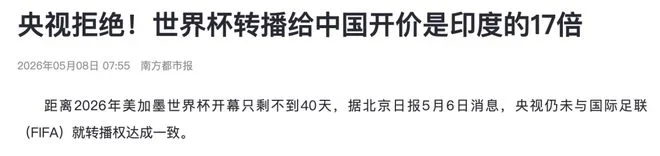
This exorbitant fee has sparked widespread media coverage. Due to a national regulation that mandates CCTV as the sole negotiator and purchaser of major international sports broadcast rights in China, the talks are strictly between FIFA and CCTV, eliminating concerns about third-party platforms driving up prices. However, FIFA is acutely aware of the immense value of the Chinese market for advertising and viewership, and senior FIFA officials have reportedly visited China recently to expedite the deal. 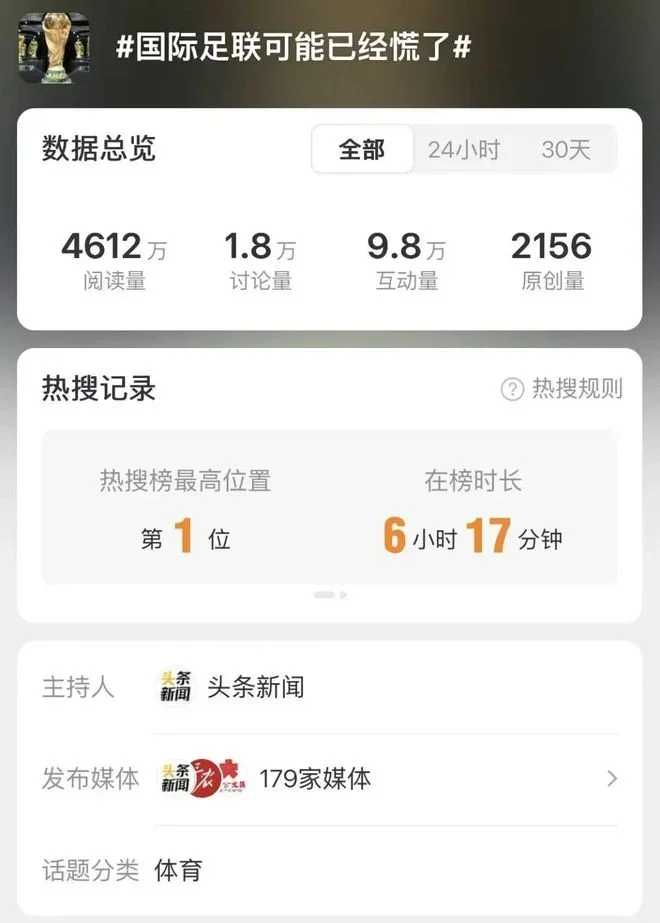
China’s national team has missed the last six World Cups, giving CCTV ample leverage to negotiate down the price. Public opinion overwhelmingly supports CCTV’s tough stance, with many suggesting FIFA should instead subsidize Chinese broadcasters for airing late-night matches.
**The End of the “Money-Rich and Easy to Fool” Era**
FIFA’s demand for $300 million seems overblown. Over the past two decades, World Cup broadcast fees in China have skyrocketed. For example, the combined rights for the 2002 and 2006 tournaments cost $24 million, while the 2010 and 2014 editions went for $115 million. The most recent two tournaments (2018 and 2022) totaled around $300 million. Emboldened by this trend, FIFA dared to ask for $250–300 million for a single tournament this time.
FIFA justifies this by classifying China as a Tier 1 market, comparable to Europe and the U.S., citing its massive population and over 200 million football fans. The tournament’s expansion to 48 teams and 104 matches also adds to the cost. Yet, this pricing is wildly disproportionate. For comparison, the U.S. paid $480 million for English-language rights, the UK secured two tournaments for $350 million, and Japan and South Korea paid $200 million and $125 million respectively. India, another populous nation with a similar football ranking to China, was quoted only $35 million for two tournaments—and is still bargaining to bring it below $20 million. 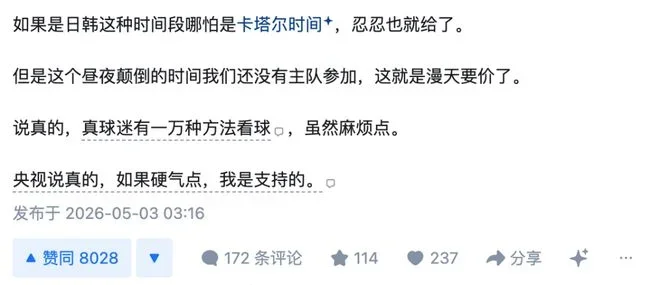
The old notion that “China’s football market is cash-rich and easy to fool” appears outdated. CCTV has previously shown resolve, such as in 2024 when it refused to broadcast the national team’s World Cup qualifiers due to excessive fees from AFC’s agent, publicly condemning “disruptive pricing.” This time, the same determination is evident.
With only 40 days left before the tournament, FIFA is under pressure. Over 70% of the matches will take place in the Americas, meaning most games will air in the dead of night in China—a scheduling drawback that weakens Asian viewership. If CCTV doesn’t broadcast, FIFA will struggle to fulfill its advertising commitments and maintain the World Cup’s status as a global event.
**FIFA: From Football Association to “Football Hooligan”**
FIFA has evolved from a sports governing body into a commercial empire centered on the World Cup. Broadcast rights alone accounted for nearly 40% of its total revenue in 2025, at $1.044 billion. The 2026 tournament is projected to generate a record $13 billion in total revenue (2023–2026 cycle), with over $3.4 billion from global broadcast rights. Looking ahead to 2027–2030, FIFA expects $14 billion in total revenue, with TV rights exceeding $6 billion.
While FIFA’s commercial acumen is undeniable, its organizational structure remains that of an association, not a transparent corporation. This opacity has fueled corruption scandals. In 2010, a BBC investigation exposed high-ranking FIFA officials accepting bribes. The 2015 U.S.-led corruption crackdown led to the arrest of numerous FIFA executives on charges of fraud, bribery, and money laundering. Former president Sepp Blatter was banned from football activities for eight years, and his secretary-general Jérôme Valcke was implicated in ticket scalping, allegedly taking a 50% cut from resales.
The 2015 scandal revealed systemic corruption, particularly in the sale of World Cup broadcast and hosting rights. Blatter was accused of selling the Caribbean TV rights for the 2010 World Cup to his friend Jack Warner for just $600,000, who later resold them for $18 million—a transaction bearing Blatter’s own fingerprint.
Despite these exposés, the core power structure remains intact. Qatar’s controversial win of the 2022 World Cup, amid allegations of “buying votes” and labor abuses resulting in over 6,000 deaths, further tarnished FIFA’s credibility. Current president Gianni Infantino has defended Qatar, dismissing criticism as hypocrisy.
FIFA’s unchecked authority allows it to set its own rules, with self-regulation largely cosmetic. This erosion of trust has made its discriminatory pricing appear even more arrogant, fueling public outrage.
**A Love That Once Was, but Now Fades**
Chinese fans are not indifferent to the World Cup. The 2002 tournament marked the pinnacle of Chinese football, when the national team qualified for the first time. It ignited a nationwide passion: the opening match drew a 9.7% rating in eight major cities, and the game against Brazil was estimated to have attracted over 700 million viewers. Over 2 billion cumulative viewers watched all three group matches through CCTV.
That era created deep emotional ties, with companies giving employees time off and schools organizing group viewings. However, the national team has missed every subsequent World Cup, turning the event into a spectacle of others’ success. Yet, the love for football endures, often expressed through bittersweet humor and frustration.
Online, many users mock the situation: “CCTV has nothing to worry about—China’s national team isn’t even in the tournament, so FIFA can’t retaliate.” Others joke that FIFA should first help China qualify, then negotiate the fee.
In the end, the broadcast rights dispute is a matter of simple market logic. While Chinese fans still cherish the dream of seeing their team again, the prolonged absence has also given them the confidence to resist exorbitant demands. Perhaps this is the national team’s greatest contribution yet.