

The plan to transform the Antônio Braz Sessin Stadium, known as Sessinzão, in Cidreira, Brazil, into a racetrack with an oval course is set to be executed in stages. While the ultimate goal is to host NASCAR events, the initial phase, outlined by the Federação Gaúcha de Automobilismo (FGA), will prioritize dirt tracks and karting to build local motorsport culture.
The FGA has already drafted the project and is the leading entity interested in taking over the area. However, financial and legal hurdles must be overcome. Other companies or organizations may also participate in the bidding process. The estimated cost of the project is R$ 50 million, and it could take up to 10 years to complete. The planned concession period is 30 years.
“We’ve spoken with the city government, which has made itself available. The process is ongoing. The municipality needs to work with the Public Prosecutor’s Office to lift the interdiction,” said architect Fernando Bittencourt, a member of the FGA development committee.
Given the scale of the investment, the entity intends to implement the plan in phases. The circuit will not be paved immediately; it will start as a dirt track. “We want to begin with a dirt track because we are strong in rally and veloterra,” said the official.
Bittencourt aims to create a motorsport culture incorporating various categories such as kart cross, rally sprint, jeep gatherings, and obstacle motorcycle events. The expectation is that this approach will generate greater public engagement and visibility, attracting new partners and enabling future improvements to the racetrack.
FGA President Arlindo Signor stated that the project and investor search should accelerate once judicial authorization is granted. “When we secure a better infrastructure, commercial area, grandstands, and an asphalt track, the project will grow. If an investor is focused on karting, we can adjust the project to allocate more space for kart tracks than for cars,” Bittencourt revealed.
Regarding NASCAR, the oval track will be 498 meters long, slightly longer than the 400-meter Bowman Gray Stadium in North Carolina, which inspired the idea. If the project advances, officials will discuss with NASCAR whether the track will have banking and other technical specifications. The current capacity of Sessinzão is 17,000 people, the same as Bowman Gray, but the FGA is considering reducing it to 12,000 for the future racetrack.
Bittencourt acknowledges that an election year complicates matters but hopes for both public and private support. The plan also includes building technical schools for underprivileged youth. “We already have interested businesspeople, but we need government involvement. There is a social, inclusion, and educational aspect—providing technical training for young people, with courses in mechanics and motorsports fundamentals,” he explained.
According to the Brazilian Institute of Geography and Statistics (IBGE), Cidreira had 17,071 residents in 2022, meaning the racetrack could accommodate nearly the entire city’s population.
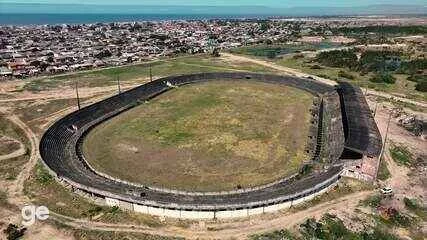
The official noted that the 2024 floods that devastated Rio Grande do Sul made the coast a refuge for people from Porto Alegre and surrounding areas. The 113-kilometer distance from the capital to the beach is another advantage in attracting people to the track. “Many people moved to the coast during that period and are passionate about racing. There is a large group of kart racers who miss having a place to compete. They currently have to travel to Porto Alegre. Cidreira is about 1 hour 40 minutes away. Depending on where someone lives in São Paulo, it can take two hours to reach Interlagos,” Bittencourt added.
On April 23, the Rio Grande do Sul court authorized the Cidreira city government to proceed with the concession of the stadium to private enterprise. The structure, abandoned for 19 years, belongs to the municipality. In November 2025, the Cidreira City Council had already approved the authorization for the city to grant the stadium area.
The abandoned stadium has been closed by court order since 2010 due to structural issues. In a recent hearing, the Municipality of Cidreira expressed a desire for assurance that the site will be unblocked for the winning bidder. The Public Prosecutor’s Office stated that the interdiction applies to using the stadium for events but only until issues are resolved, either directly by the municipality or by a partner. The office committed to providing documentation for analysis, including technical corrections to reports, feasibility assessments for renovations and adaptations, and any additional safety requirements.
The Antônio Braz Sessin Stadium, nicknamed Sessinzão, was inaugurated in 1996 at a cost of just over R$ 2 million. Its goal was to boost economic activity and put Cidreira on Brazil’s football map. The city’s population of just over 17,000 would not fill all seats. Currently, the site looks more like a pile of debris than a venue for Grêmio and Internacional matches. The Gre-Nal rivals did play some Gauchão matches there. Nearly three decades after its opening, the stadium hosted only 19 official football matches, the last in 2007. Shortly after, in 2010, it was closed due to structural and licensing issues, becoming more of a problem than a leisure option in the quiet coastal town.